Field note
Sleep has been hit-or-miss for me lately. Travel, late-night thinking, the occasional kid wake-up — usual reasons, nothing dramatic.
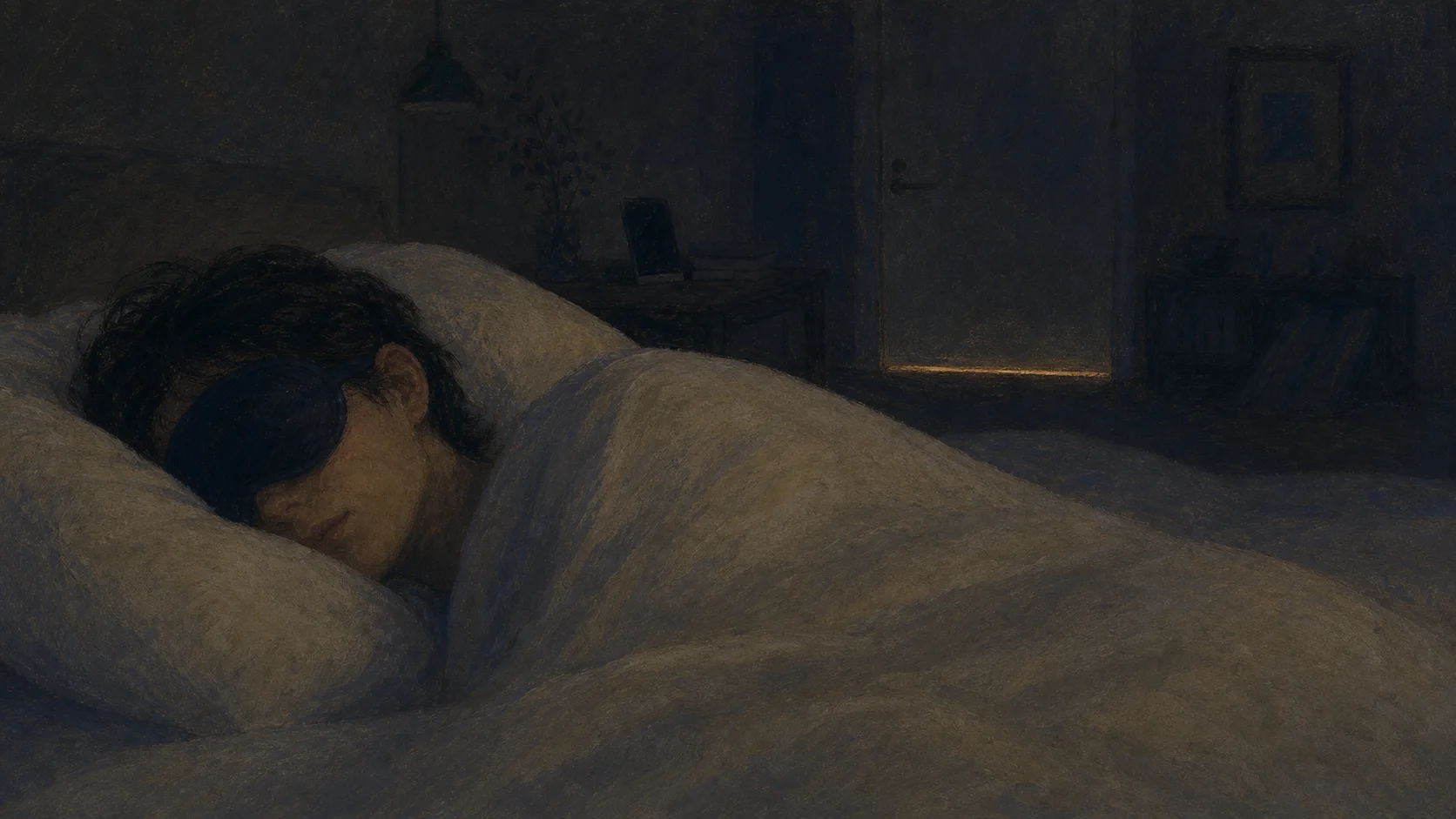
The strange thing is that a sleep mask helps more than I expected. Not because my room is especially bright. It is more like the moment I put it on, the world gets smaller: no ceiling, no phone across the room, no small visual reminders that I am still available to the day.
I used to think sleep masks were mainly about blocking light. Lately it feels more like they block the day from continuing.
“A sleep mask is like a light switch for your brain.”
What Reddit added
I posted a version of this thought in a sleep community, and the useful part was not that people agreed eye masks were nice. The useful part was how they described the mechanism.
One person pointed out that even with eyes closed, the visual system can still feel partly on: ambient light, small motion, the room being faintly there. Another described a good mask as a kind of switch. That phrasing stuck because it is not about making sleep happen. It is about making the room stop asking to be monitored.
That is the difference between a sleep tip and a field note. “Wear an eye mask” is a tip. “The room still feels available, and the mask removes that availability” is a pattern.
The pattern
The pattern is simple: for some people, lying in a dark room is not the same as the visual world being off duty. The ceiling, the outline of the phone, a strip of light under the door, the sense of objects around you — none of these have to be dramatic to keep a little scanning loop alive.
A blackout mask changes the boundary. It gives the body a physical signal: nothing else is coming in through this channel right now. The room may still be there, but it is no longer asking for visual attention.
That does not mean everyone needs a sleep mask. It means that for some nights, the problem is not “I need a stronger sleep trick.” The problem is that the world still feels slightly open.
Science anchor
The science here is not that eye masks are a treatment for insomnia. The safer claim is narrower: light and visual input are part of the body’s alerting system, and insomnia is often maintained by arousal — the body staying more ready, watchful, or evaluative than the moment requires.
Sleep researchers often distinguish sleep itself from the systems that permit sleep: circadian timing, homeostatic pressure, arousal, safety, and learned associations. A mask does not fix all of those. But it may reduce one stream of input that keeps the room feeling available.
That is why the effect can feel bigger than the object. The mask is small. The signal can be larger: you do not have to keep visually checking the world.
Try tonight
If you already own a comfortable eye mask, try this as an observation, not a protocol: put it on for ten minutes before you are trying hard to sleep. Do not ask whether it makes you sleep faster. Ask whether the room feels less available.
If the answer is yes, the useful finding is not “eye masks are magic.” It is that your sleep may be sensitive to the feeling that the world is still open. That is a different problem, and it gives you a different thing to notice.
References and anchors
- Reddy, S., Reddy, V., & Sharma, S. (2025 update). Physiology, Circadian Rhythm. StatPearls. NCBI Bookshelf.
- Riemann, D. et al. (2010). The hyperarousal model of insomnia: a review of the concept and its evidence. Sleep Medicine Reviews, 14(1), 19-31. doi:10.1016/j.smrv.2009.04.002.