Field note
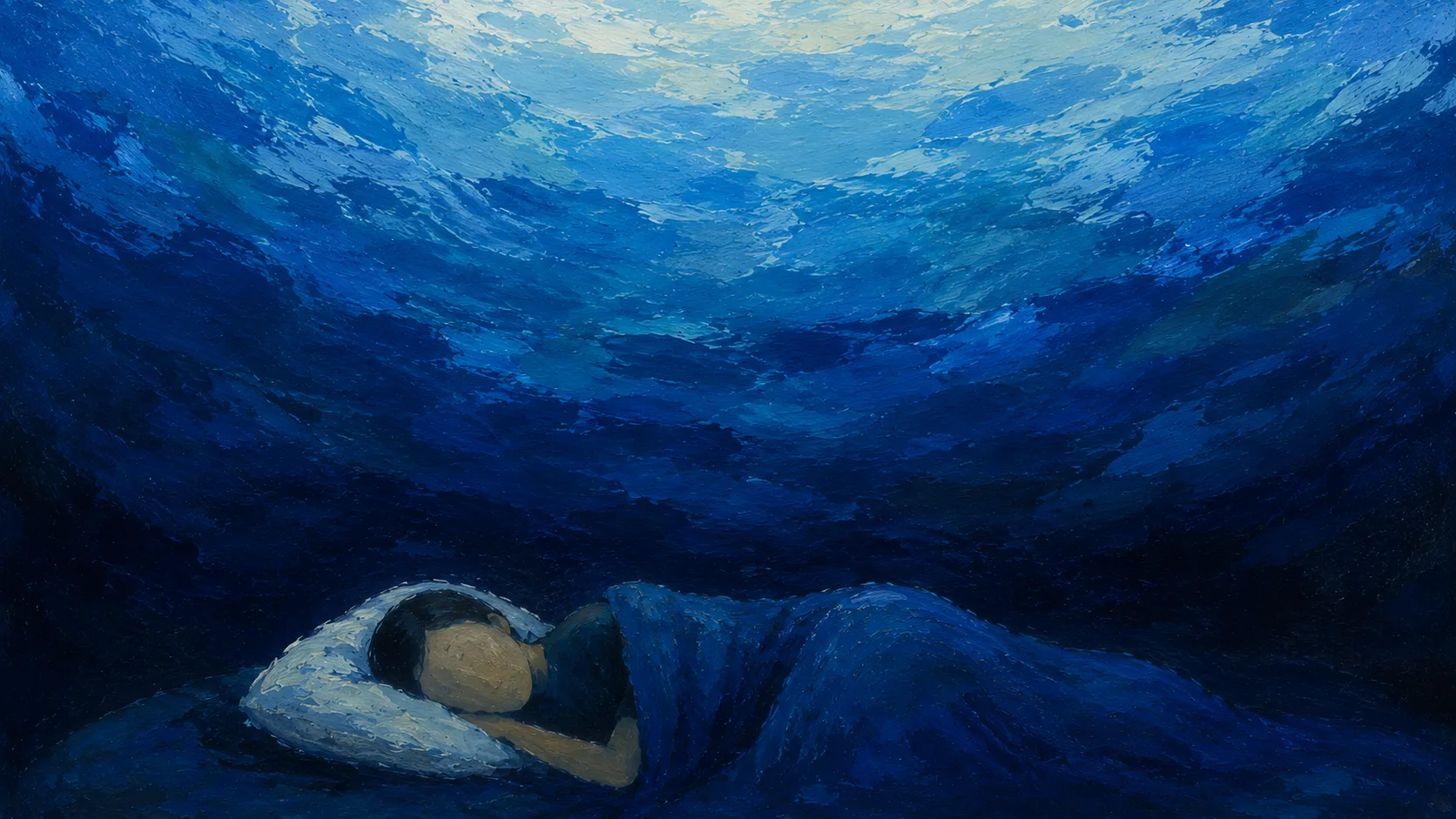
My wife studied art, and one day she showed me a painting from a class where the theme was depth. It was not a sleep painting in any technical sense. It was about color, composition, and how a flat surface can feel deep.
But when I saw it, I did not think about color theory. I thought: this is what deep sleep looks like.
Not what the sleeper is consciously feeling. That distinction matters. If we are talking about sleep stages, deep sleep usually means N3, or slow-wave sleep. It is not a claim that someone is having an underwater experience inside that stage.
The image worked for me in a different way: as an outside view.
A person asleep under a heavy blue space. The day is still there, but it has moved farther away. Sounds seem muted. The body looks unavailable to the world. Not switched off exactly, but below the surface.
Deep sleep is not always something you feel. Sometimes it is something others can no longer reach.
Reader notes
I posted the image because it named something for me. The comments made the note better because they did not all agree in the same way. Some people completed the metaphor. Some corrected it. Some pushed against it. That is the useful part.
Reader language
“unreachable rather than just unconscious”
This was the strongest phrase in the thread because it separated two things that often get blurred together. "Unconscious" is a state description. "Unreachable" is relational. It tells you what happened between the sleeping body and the world around it.
That is what the image seemed to hold. The person is not merely off. The day has lost access. The phone cannot call them back. The room cannot ask for anything. The surface world is still above them, but it no longer has a handle.
Reader language
“nothing is asking for you”
This line landed because it gets at a quieter part of sleep than rest. A lot of bad sleep is not only wakefulness. It is availability: the sense that some part of you is still listening for the next demand.
Deep sleep, in everyday language, often means that availability finally drops. The body is not negotiating with the room. It is not keeping one ear open for the day. Nothing is asking, so nothing has to answer.
Reader correction
“not truly deep sleep”
This correction mattered. If we are being precise, deep sleep usually means N3, or slow-wave sleep. The image should not be treated as a report from inside that stage. The person in the picture is not telling us what N3 feels like.
The cleaner frame is outside view. We are looking at a body that appears to have crossed some threshold of availability. The metaphor is about how deep sleep can look from the room, not what a brain is consciously narrating during N3.
Reader counter-reading
“scares me more”
This was useful because it kept the image from becoming too tidy. Underwater quiet is not automatically peaceful. For some people, distance from the day feels like relief. For others, the same distance can feel like loneliness, disappearance, or deep-water anxiety.
That is not a contradiction. It is the condition underneath the whole note: sleep asks for distance, but distance only helps when it feels safe. Without safety, being beyond reach can look less like rest and more like isolation.
Reader bridge
“loose, non-linear state before dreams”
Another reader connected the image to word shuffle, cognitive shuffle, and the drifting state before dreams. That is not the same as deep sleep, but it belongs near the same descent.
Falling asleep often does not feel like a neat switch. It can feel like the mind losing its normal sentence structure. Scenes arrive without being chosen. A phrase turns into a picture. A picture becomes a place. The day is not gone yet, but its logic is starting to soften.
What the thread clarified
The image was not useful because it proved one thing. It was useful because it separated several things that hide inside the phrase "deep sleep."
There is the technical label: N3, slow-wave sleep, the language of sleep staging. There is the outside view: someone is harder to reach, less responsive, less available to the room. There is the inside transition: the loose, drifting, pre-dream state where thought stops behaving like a task list. And there is the emotional meaning: distance can feel safe, lonely, peaceful, or frightening depending on the person.
A useful field note does not collapse those into one answer. It keeps them apart. The image is strongest when it is allowed to be a metaphor with edges, not a scientific diagram pretending to be exact.
Science boundary
In sleep medicine, deep sleep usually refers to N3 sleep, also called slow-wave sleep. It is part of non-REM sleep and is often discussed in relation to sleep depth, arousal threshold, and physical restoration.
This note is not saying that someone consciously experiences an underwater scene during N3. It is about the gap between technical sleep language and everyday sleep language. People often recognize "deep sleep" from the outside: the body is less responsive, the room stops mattering, and the person looks unreachable in a way that ordinary rest does not.
Subjective sleep quality and measured sleep stages are related, but they are not the same thing. A person can have a technical sleep report and still need language for what the night felt like. A field note lives in that gap.
What to notice
The next time you say you slept deeply, notice what you mean. Do you mean you had a long stretch without waking? That you were hard to wake? That the morning felt less damaged? That the world disappeared cleanly enough that you did not have to keep track of it?
These are not identical experiences. Naming the difference matters because it keeps a useful metaphor from turning into a false claim.
Maybe the strongest sleep does not need to be remembered clearly. Maybe it only has to leave evidence: the body looked unreachable, and the day had to wait.
References and anchors
- Patel, A. K., Reddy, V., & Araujo, J. F. (2025 update). Physiology, Sleep Stages. StatPearls. NCBI Bookshelf.
- Carskadon, M. A., & Dement, W. C. (2011). Normal human sleep: an overview. In Principles and Practice of Sleep Medicine. NCBI Bookshelf.